
Browse All Records(188 total)
- Collection: Unpacking Our History Interviews
Emily Dufton: Methadone, Suboxone, and the War on Drugs
Emily Dufton discusses her book Addiction, Inc.: Medication-Assisted Treatment and America’s Forgotten War on Drugs. It’s the history of the federal development and subsequent commercialization of the opioid addiction medication industry. Beginning with the Johnson Administration, the reasons the Federal response to and creation of drug policy moved from harm reduction to carceral solutions are explored. Emily Dufton, drug historian and writer, her writing has appeared in the Washington…

Emily Widra: Police Contact and Disparity
Emily Widra discusses her article, "Despite fewer people experiencing police contact, racial disparities in arrests, police misconduct, and police use of force continue." By looking at the newly released Bureau of Justice Statistics report that collects data of police contact in 2022, she finds that even while fewer people interacted with police than in prior years troubling police behavior remains consistent. Emily Widra is a Senior Research Analyst at the Prison Policy…
Eric Foner: Reconstruction's Consititution
Eric Foner, DeWitt Clinton Professor Emeritus of History at Columbia University, is one of this country's most prominent historians. Professor Foner discusses his book "The Second Founding: How the Civil War and Reconstruction Remade the Constitution." By looking at the history of debate and aftermath of each Post-War Amendments, Prof. Foner examines how each sought to permanently end American Slavery.
Eric Herschthal: Dr. Rush's Leprosy Theory
Eric Herschthal is an assistant professor of history at the University of Utah. Professor Eric Herschthal discusses his article "The Science of Antislavery in the Early Republic: The Case of Dr. Benjamin Rush." Prof. Herschthal examines how the medical theories of Dr. Rush informed his advocacy for the American Revolution and the end of American Slavery. While some of the ideas Dr. Rush came up with seem far-fetched or deplorable today, during his lifetime, his thinking was immensely…
Erica Meiners: Childhood and Carceral Society
Erica R. Meiners is a Professor of Education and Women’s and Gender Studies at Northeastern Illinois University. Professor Erica Meiners discusses her book, For the Children? Protecting Innocence in a Carceral State, in which the definition of childhood become an ideological state used to push back against resistance and reform. Childhood, Meiners states, depends on social constructions and differ based on the group it refers to - freed slaves were talked about as children, while white wealthy…
Erin Thompson: Smashing Monuments
Erin L. Thompson is a professor of art crime at the City University of New York. Professor Erin Thompson discusses her book, "Smashing Statues: The Rise and Fall of America's Public Monuments." Prof. Thompson explains the role of Confederate monuments, what they symbolize, and to whom their message is aimed. The design of the "parade stance" figure's rise to monument dominance provides insight into the submissive posture of white defender was intentional. Thompson…

Felicity Turner: Proving Pregnancy
Felicity Turner, Associate Professor in the Department of History at Georgia Southern University, discusses her book Proving Pregnancy: Gender, Law, and Medical Knowledge in Nineteenth-Century America. Professor Turner explores the intersection of law and the emerging medical professionalization in cases of infanticide in the United States. By examining the legal documents, she is able to show how women's knowledge was invaluable to pregnancy and birth, often called to be expert witnesses…
Fergus Bordewich: War on the Klan
Fergus Bordewich discusses his newest book, Klan War: Ulysses S. Grant and the Battle to Save Reconstruction. Mr. Bordewich explains how the Klu Klux Klan was America's first terrorist organization intent on counterrevolution after the Civil War. How President Grant mobilized the Federal government to challenge and ultimately dismantle the Klan is the subject of the interview. Fergus Bordewich is an American writer, popular historian, and editor living in San Francisco. He is the author of…
Fran Shor: White Identity Politics
Francis Shor is an Emeritus Professor of History at Wayne State University. Professor Fran Shor talks about his book, Weaponized Whiteness [https://www.haymarketbooks.org/books/...] which interrogates the meanings and implications of white supremacy and, more specifically, white identity politics from historical and sociological perspectives. Prof. Shor looks at the history of immigration, slavery, and moments of resistance against White Supremacy. Examining how white people participated in the…
Frank Cooper: Cop Fragility and Blue Lives Matter
Frank Rudy Cooper is the William S. Boyd Professor of Law and Director, Program on Race, Gender & Policing at the University of Nevada, Las Vegas. Professor Frank Rudy Cooper discusses his article, "Cop Fragility and Blue Lives Matter." Professor Cooper discusses how after the rise of Black Lives Matter protests and reform efforts, police responded with a varied and detailed list of their own grievances. Blue Lives Matter emerged as a way to reframe police reform efforts by…
Gabriel Schwartz: Evictions and Health Risks
Gabriel L. Schwartz discusses his work on “Eviction as a Community Health Exposure.” and “Moving due to unaffordable housing and disrupted social safety net access among children.” He talks about how moving and evictions lead to sometimes catastrophic health outcomes based on losing access to social safety net programs. Evictions upend people’s lives and the effect on children is great. Gabriel L. Schwartz, Assistant Professor Health Management & Policy, Drexel FIRST Program at Drexel…
Gerald Horne: Colonialism: Religion, Class, Race
Gerald Horne is an American historian who holds the John J. and Rebecca Moores Chair of History and African American Studies at the University of Houston. Professor Gerald Horne discusses his book, The Dawning of the Apocalypse: The Roots of Slavery, White Supremacy, Settler Colonialism, and Capitalism in the Long Sixteenth Century. Prof. Horne explains his thesis that religion, which supported so much colonial expansion, gave way to race, specifically whiteness, as a way of organizing conquest.…
Gerald Horne: Texas: Race, War, Colonialism
Professor Gerald Horne discusses his book, The Counter-revolution of 1836: Texas Slavery & Jim Crow and the Roots of American Fascism. Prof. Horne explains his thesis that Texas was a goldmine for Euro-Americans since it provided the dual economics of land speculation and the expansion of slavery, praxis for settler colonialism, and a built in challengers to white supremacy in Mexico and the Native Americans. Texas served as a lynchpin in the coming of the Civil War and a proving ground for…
Gian Maria Campedelli: Black Homicide Victims
Gian Maria Campedelli, research scientist at Fondazione Bruno Kessler in Italy, discusses his research article, “Homicides Involving Black Victims are less likely to be Cleared in the United States.” Drawing upon three databases the FBI’s national incident-based reporting system (NIBRS) and the Murder Accountability Project (MAP), Campedelli found that homicides with Black victims were between 3.4% and 4.8% less likely to be solved by police. Gian Maria Campedelli, a research scientist in…
Giuliana Perrone: Abolition’s Legal Failures
Giuliana Perrone, Professor of History, University of California, Santa Barbara, discusses her book, Nothing More than Freedom: The Failure of Abolition in American Law. Professor Perrone explains how emancipation and abolition stalled and were ultimately defeated in the Courts. After the Civil War, State courts became the location that set the terms of racial identity, civil rights, and national belonging. These decisions posed a purposeful resistance to the post-War reimagining of the American…

Grace E. Howard: Eugenics, Drugs, and Fetal Personhood
Grace Howard discusses her book, The Pregnancy Police: Conceiving Crime, Arresting Personhood . Professor Howard illustrates how our society has regulated and criminalized pregnancy, through the history of eugenic race science, the war on drugs, fetal personhood laws. Slowly, medical professionals fell in line with prosecutors and police to enforce fetal assault laws with increasing risks to women, families, and ultimately, society. Grace Howard is an Associate Professor of Justice Studies…
Hasan Kwame Jeffries: Black Power in Alabama
Hasan Kwame Jeffries is an associate professor of history at The Ohio State University. Professor Hasan Jeffries discusses his book Bloody Lowndes: Civil Rights and Black Power in Alabama’s Black Belt. We talk about what made this rural Alabama County such an important and complicated location in the Civil Rights struggle. How school desegregation and voting registration was still accomplished in the shadow of some of the era's worst white terrorism. And how the Black Power slogan was born,…
Heather Ann Thompson talks her new book, Fear and Fury: The Reagan Eighties, the Bernie Goetz Shootings, and the Rebirth of White Rage. In it she explores a pivotal moment in American history when new conservative media landscape is emerging, the Reagan Revolution is recoding racism, and the social fabric of the New deal is unraveling, all which helps contextualize a vigilante shooting on a NYC subway train on Dec 22 1984. Heather Ann Thompson is a historian at the University of Michigan and…
Heather O’Connell: Confederate Monuments and Anti-Black Stereotypes
Heather O'Connell discusses her article, "Confederate Monuments and Anti-Black Stereotypes in the US South." Her research points to a strong link between Confederate monuments and heightened anti-Black stereotypes among white Southerners, particularly in areas with a high density of such monuments. She argues the observed relationship is driven by racialized cultural frames emphasizing the Black-White boundary that are linked to Confederate monuments with a “Lost Cause”…
Herman Bennett: African Kings, Iberian Traders, and Black Slaves
Herman Bennett talks about his book, African Kings and Black Slaves Sovereignty and Dispossession in the Early Modern Atlantic. It is an examination of how early modern African-European encounters offer a rethinking of these exchanges as being solely about the slave trade and racial difference. By asking how Europeans and Africans thought about sovereignty, polities, and subject status, Bennett offers a new take on the slaves' experiences in the Americas. Herman Bennett is the Executive…
Ibriham Sudiata: Slavery and the 1619 Project
Professor Ibrahim K. Sundiata is Emeritus Professor of History and African and African American Studies at Brandeis University. A member of the Council on Foreign Relations, the researcher has traveled extensively in South America, the Middle East and Australia. Sundiata currently resides in Salvador da Bahia, Brazil, where he has held a Fulbright Professorship at the Universidade Federal da Bahia (UFBA -Federal University of Bahia). He is the author of four books; his last is on the Garvey…

Inga Trauthig: Artificial Intelligence and World Elections
Inga Trauthig discusses her co-authored study for the International Panel on the Information Environment, “The Role Of Generative AI Use in the 2024 Elections Worldwide.” What are the implications of GenAI for election administration and voter participation around the world? This assessment delivers the first global, data-driven analysis of its kind, designed to inform policy recommendations Inga Trauthig is a research professor at the Jack D. Gordon Institute for Public Policy at Florida…
J. Russell Hawkins: Segregationist Theology
J. Russell Hawkins discusses his book, The Bible Told Them So: How Southern Evangelicals Fought to Preserve White Supremacy. Why did southern white evangelical Christians resist the civil rights movement in the 1950s and 1960s? Simply put, they believed the Bible told them so. These white Christians entered the battle against integration and civil rights certain that God was on their side. J. Russell Hawkins is Professor of Humanities and History in the John Wesley Honors College at Indiana…
Jacob Glick: Violent Extremists of Jan. 6th
Jacob Glick was counsel to Representative Jamie Raskin on the House Oversight Committee, Subcommittee on Civil Rights and Civil Liberties, managing its years-long investigation into violent white supremacy. He also served on the legal team for the House Managers during the second impeachment trial of former President Donald J. Trump. Jacob Glick, Policy Counsel at the Institute for Constitutional Advocacy and Protection at Georgetown University Law Center, served as Investigative Counsel, Select…
James Oakes: Lincoln and the Antislavery Constitution
James Oakes is one of our foremost Civil War historians and a two-time winner of the Lincoln Prize for his works on the politics of abolition. He teaches at the Graduate Center of the City University of New York. He discusses his book, The Crooked Path to Abolition Abraham Lincoln and the Antislavery Constitution. Beginning with the inclusion of the 3/5th clause and the fugitive slave clause in the Constitution there existed a tension between a proslavery and antislavery interpretation. How did…

Jane Borden: Doomsday Cults and America
Jane Borden discusses her book, Cults Like Us: Why Doomsday Thinking Drives America. She explains why the doomsday beliefs of our Puritan founders still drive American culture. Tracing threads of our latent Puritan indoctrination through eugenic cults, prosperity gospel, and the current rise in far-right extremism, she proposes that the United States might just be largest cult of all. Jane Borden is an author, culture journalist, and editor. She contributes regularly to Vanity Fair, and has…
Jaquelyn Jahn: Police Violence and Pregnant People
Jaquelyn Jahn, Assistant Professor of Epidemiology at Drexel University, discusses her articles "Neighborhood Proactive Policing and Racial Inequities in Preterm Birth in New Orleans, 2018‒2019" and "Gestational Exposure to Fatal Police Violence and Pregnancy Loss in U.S. Core Based Statistical Areas, 2013-2015." Professor Jahn discusses how police violence and over-policing disproportionately affects Black, Native American, and Hispanic people, and increases the risk of…
Jason Morgan Ward: White Democaracy: Democrats become Republicans
Jason Morgan Ward is professor of history at Emory University. Professor Jason Morgan Ward discusses his book Defending White Democracy: The Making of a Segregationist Movement and the Remaking of Racial Politics, 1936-1965. Starting in the 1930s at the advent of the New Deal, Southern Democrats came to face a growing threat to Jim Crow and White Supremacy. New Deal agencies seemed to threaten Federal intrusion into labor and social norms that held white people in power. After World War II,…
Jefferson Cowie: White Resistance to Federal Power
Jefferson Cowie discusses his 2022 book, "Freedom’s Dominion: A Saga of White Resistance to Federal Power." By examining the local history of Barbour County in Alabama, Professor Cowie develops a thesis of white freedom which dependent upon the oppression of others. Tracing the origins in white intrusion into Creek lands and the Federal response to these intruders, the idea of racialized anti-statism begins to form around sovereignty and "outsider" interference in local…
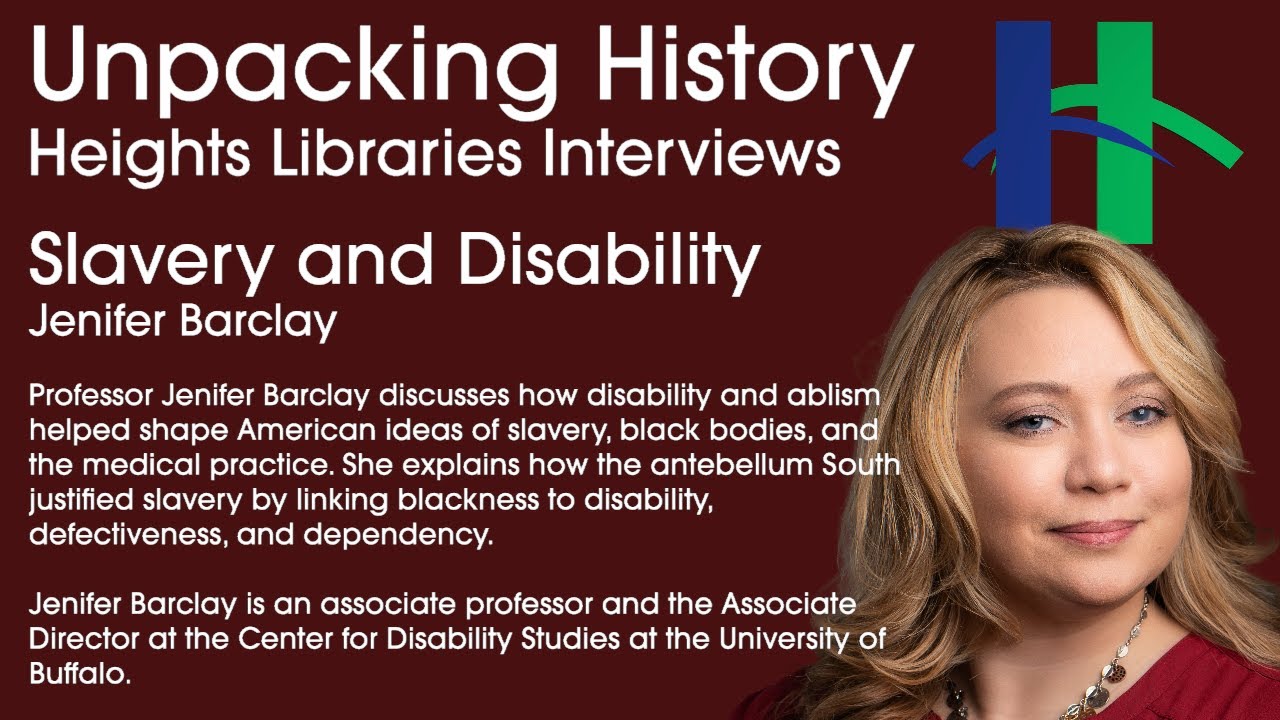
Jenifer Barclay: Slavery and Disability
Jenifer Barclay is an associate professor and the Associate Director at the Center for Disability Studies at the University of Buffalo. Professor Jenifer Barclay discusses how disability and ablism helped shape American ideas of slavery, black bodies, and the medical practice. She explains how the antebellum South justified slavery by linking blackness to disability, defectiveness, and dependency. Both proslavery and abolitionists used disability as a frame to further their arguments about the…