
Browse All Records(204 total)
Jacob Glick: Violent Extremists of Jan. 6th
Jacob Glick was counsel to Representative Jamie Raskin on the House Oversight Committee, Subcommittee on Civil Rights and Civil Liberties, managing its years-long investigation into violent white supremacy. He also served on the legal team for the House Managers during the second impeachment trial of former President Donald J. Trump. Jacob Glick, Policy Counsel at the Institute for Constitutional Advocacy and Protection at Georgetown University Law Center, served as Investigative Counsel, Select…
James Oakes: Lincoln and the Antislavery Constitution
James Oakes is one of our foremost Civil War historians and a two-time winner of the Lincoln Prize for his works on the politics of abolition. He teaches at the Graduate Center of the City University of New York. He discusses his book, The Crooked Path to Abolition Abraham Lincoln and the Antislavery Constitution. Beginning with the inclusion of the 3/5th clause and the fugitive slave clause in the Constitution there existed a tension between a proslavery and antislavery interpretation. How did…

Jane Borden: Doomsday Cults and America
Jane Borden discusses her book, Cults Like Us: Why Doomsday Thinking Drives America. She explains why the doomsday beliefs of our Puritan founders still drive American culture. Tracing threads of our latent Puritan indoctrination through eugenic cults, prosperity gospel, and the current rise in far-right extremism, she proposes that the United States might just be largest cult of all. Jane Borden is an author, culture journalist, and editor. She contributes regularly to Vanity Fair, and has…
Jaquelyn Jahn: Police Violence and Pregnant People
Jaquelyn Jahn, Assistant Professor of Epidemiology at Drexel University, discusses her articles "Neighborhood Proactive Policing and Racial Inequities in Preterm Birth in New Orleans, 2018‒2019" and "Gestational Exposure to Fatal Police Violence and Pregnancy Loss in U.S. Core Based Statistical Areas, 2013-2015." Professor Jahn discusses how police violence and over-policing disproportionately affects Black, Native American, and Hispanic people, and increases the risk of…
Jason Morgan Ward: White Democaracy: Democrats become Republicans
Jason Morgan Ward is professor of history at Emory University. Professor Jason Morgan Ward discusses his book Defending White Democracy: The Making of a Segregationist Movement and the Remaking of Racial Politics, 1936-1965. Starting in the 1930s at the advent of the New Deal, Southern Democrats came to face a growing threat to Jim Crow and White Supremacy. New Deal agencies seemed to threaten Federal intrusion into labor and social norms that held white people in power. After World War II,…
Jefferson Cowie: White Resistance to Federal Power
Jefferson Cowie discusses his 2022 book, "Freedom’s Dominion: A Saga of White Resistance to Federal Power." By examining the local history of Barbour County in Alabama, Professor Cowie develops a thesis of white freedom which dependent upon the oppression of others. Tracing the origins in white intrusion into Creek lands and the Federal response to these intruders, the idea of racialized anti-statism begins to form around sovereignty and "outsider" interference in local…
Jenifer Barclay: Slavery and Disability
Jenifer Barclay is an associate professor and the Associate Director at the Center for Disability Studies at the University of Buffalo. Professor Jenifer Barclay discusses how disability and ablism helped shape American ideas of slavery, black bodies, and the medical practice. She explains how the antebellum South justified slavery by linking blackness to disability, defectiveness, and dependency. Both proslavery and abolitionists used disability as a frame to further their arguments about the…
Jennifer Morgan: Motherhood and Slavery
Jennifer L. Morgan is Professor of History in the department of Social and Cultural Analysis at New York University where she also serves as Chair. She is the author of Reckoning with Slavery: Gender, Kinship and Capitalism in the Early Black Atlantic. Professor Morgan discusses recent journal article “Partus Sequitur Ventrem: Law, Race, and Reproduction in Colonial Slavery." Exploring how Virginia laws developed to codify enslaved women's reproductive labor, by defining and…
Jessica Katzenstein: Problems in Police Training
Police reform advocates often push police departments to move from fear-laden “warrior” survival trainings and toward reality-based or scenario trainings, which involve immersive role-playing scenarios such as making an arrest. Scenario trainings promise to teach officers to suppress fear, counter racial bias, and calibrate “reasonable” uses of force. But these trainings often fall short of their promise and end up reinforcing the threats and survival mindset. Drawing on 16 months of…
Jessica Katzenstein: Scenario Training and Police Reform
Jessica Katzenstein completed her PhD in Anthropology at Brown University in 2022. She is currently a postdoctoral fellow at Harvard University's Inequality in America Initiative though 2024. Dr. Jessica Katzenstein discusses her research on how U.S. police officers absorb and resist reforms during a mounting legitimacy crisis. She explores why reforms fail to realize their promises to curb racialized violence. Drawing on ethnographic fieldwork with officers and reformers in Maryland, she…

Jessica Pishko: Constitutional Sheriffs
Jessica Pishko is a journalist and lawyer who graduated from Harvard Law School and Columbia University’s MFA program. Jessica Pishko, journalist and lawyer, discusses her book, "The Highest Law in the Land: How the Unchecked Power of Sheriffs Threatens Democracy," in which she walks through the long history of the American Sheriff. Since the 1960s, sheriffs have consistently moved to the right, claiming to be the final and only authority to enforce and defend the Constitution. Since…
Jim Wallis: White Christian Nationalism and the Church
Jim Wallis, the founding Director of the Georgetown University Center on Faith and Justice, discusses his book, The False White Gospel: Rejecting Christian Nationalism, Reclaiming True Faith, and Refounding Democracy. He argues that the civic promotion of fear, hate, and violence as the trajectory of our politics under a banner of Christian Nationalism, should be faced to contend with a greater response of a civic faith of love, healing, and hope to defeat it. Jim Wallis is the Chair in Faith…
Joanna Schwartz: Unaccountable Policing
Joanna Schwartz is a professor of law at UCLA. Professor Joanna Schwartz discusses her new book, Shielded: How The Police Became Untouchable. Prof. Schwartz draws on her experience as a civil rights attorney and law professor to explain how Section 1 of the Klu Klux Klan Act of 1871, known as Section 1983, set the groundwork for protections for state employees, most notably police officers, when they violate a citizen's civil rights. As civil cases against police violence reached the…
Joanna Wuest: LGBTQ+ Rights
Joanna Wuest is an assistant professor of politics at Mount Holyoke College in Massachusetts. Joanna Wuest discusses her book, Born This Way: Science, Citizenship, and Inequality in the American LGBTQ+ Movement. How did LGBTQ+ civil rights leaders address moral, medical, and legal obstacles to change the way American society views them and their communities? While society has come a long way in accepting and understanding Queer people, there is a renewed backlash that threatens these hard-won…
Jocelyn Simonson: Radical Acts of Justice
Professor Jocelyn Simonson talks about her book, Radical Acts of Justice: How Ordinary People Are Dismantling Mass Incarceration. Beginning with a close look at the ideological meaning behind calling the prosecution, “The People,” Prof. Simonson points out how the criminal justice systems defines “community.” By looking at several ways activists and volunteers engage in organized efforts centered around bail, court watching, and participatory defense, Prof. Simonson shows how justice is changing…
John Kyle Day: Southern Manifesto
John Kyle Day, Professor of History at University of Arkansas at Monticello, discusses his book, The Southern Manifesto: Massive Resistance and the Fight to Preserve Segregation. Professor Day looks at the congressional statement drafted and signed by 99 congressmen aimed against Brown V. Board of Education's decision to desegregate public schools. The statement, nicknamed the Southern Manifesto, accomplished both the white supremacist's goal of blocking Civil Rights while providing…

Jonathan Haines: Genetics and Alzheimer's Disease
Jonathan Haines is a researcher and educator with experience in all aspects of genetic epidemiology, with a particular focus on illuminating the genetic architecture of complex diseases. We discussed his research into the genetic origins of Alzheimer's and dementia. His work seeks to include diverse and minority populations to expand the scope of what factors might contribute to disease prevention. He clarifies genetic research's purpose and use in the future. Dr. Jonathan Haines is…
Jonathan Wells: Southern Manifesto
Jonathan Daniel Wells, Ph.D., is Professor of History in the Residential College, the Department of Afroamerican and African Studies, and the Department of History at the University of Michigan.. His most recent books are Blind no More: African American Resistance, Free Soil Politics, and the Coming of the Civil War and The Kidnapping Club: Wall Street, Slavery, and Resistance on the Eve of the Civil War. Prof. Wells points to the Fugitive Slave Act and Northern resistance to the Federal Law as…

Jonathan Witmer-Rich: Cuyahoga County Bail Reform
Jonathan Witmer-Rich discusses his work on the ”Cuyahoga County Bail Task Force: Report and Recommendations.” Professor Witmer-Rich explains the bail situation in Cuyahoga County. Looking at cash bail as a means to secure future appearances and reduce risk, courts are actually preemptively incarcerating and punishing citizens who are presumed innocent. We talk about how the Ohio Supreme Court and Ohio voters responded to recommendations for felony bail reform. Jonathan Witmer-Rich is the…
Jonneke Koomen: Teaching Black Internationalism
Jonneke Koomen discusses her two articles, “International Relations/Black Internationalism” and “Madness in the Classroom: Thomas Sankara’s Disobedient International Relations.” Professor Koomen shows how introducing W.E.B. du Bois’ essays and speeches by Thomas Sankara places teaching about international relations into conversation with its critics. Colonialism, white supremacy, and race based economic systems served as the foundations of International Relations theory and practice, but by…

Josh Cowen: History of School Vouchers
Josh Cowen discusses his new book, The Privateers: How Billionaires Created a Culture War and Sold School Vouchers. Prof. Cowen traces voucher history startingvwith the ideological roots as a reaction to the Brown decision to how Christian nationalists use vouchers today to weaken the free exercise clause, As challenges to vouchers continue, the defense and advocacy moved into culture war rhetoric to distract from the dismal metrics about voucher success. Josh Cowen is a professor of education…
Julie Farnam: Inside the January 6th Insurrection
Julie Farnam discusses her book, "Domestic Darkness: An Insider's Account of the January 6th Insurrection, and the Future of Right-Wing Extremism" After being named Assistant Director of Intelligence for the Capitol Police just days before the 2020 election. She warned Capitol Police leadership of planning and coordination online which led to the insurrection. Her report sharing that "Congress itself is the target on the 6th." Her warnings were ignored. She recounts the…
Justin Brooks: Why You Might End Up In Prison
Professor Justin Brooks, director of the LLM Program in U.S. Law in Spanish at the University of San Diego, discusses his book, You Might Go to Prison, Even Though You're Innocent. Prof. Brooks explains how bad lawyering, bad science, and inadequate investigations, lead to wrongful conviction. We look into how police interrogations and juries all contribute to a broken justice system, where innocence is no protection from incarceration. Professor Brooks directs the LLM Program in U.S. Law…

Kali Gross: Vengeance Feminism
Kali Gross discusses her book, Vengeance Feminism: The Power of Black Women's Fury in Lawless Times. Prof. Gross looks at the stories of Black women who hit back—not always figuratively, and not always legally either. Reckoning with women who lied, robbed, and cheated a racist, misogynistic world, these women's stories illustrate how they grappled with the daily violence of their lives. Kali Gross is the National Endowment for the Humanities Professor of African American Studies at…

Kate Weisburd: The Carceral Home
Kate Weisburd discusses her article, The Carceral Home. As prison walls are replaced with parole and probation rules that govern every aspect of private life, invasive surveillance technologies are used to monitor intimate information. Where does that leave the private home's primacy as first among equals? Data collection, audio recording, and GPS technologies are expanded to punish people in open society. Professor Wesiburd explores how these issues interact with each other and complicate…
Katharina Motyl: From “Feminist Lies” to “White Replacement”
Katharina Motyl discusses her chapter, "From “Feminist Lies” to “White Replacement”: Digital Anti-Feminist Forums as Spaces of Collective Radicalization.”Which explores how the "manosphere" draws men and boys into a world of increasingly radical far-right ideologies, through grievance and misogyny . Prof. Motyl explores how digital platforms enable the spread of extremist ideologies, transforming individual grievances into collective radicalization and influencing offline…
Katharine Gerbner: Christian Slavery
Katharine Gerbner is an Associate Professor of History at the University of Minnesota. Professor Katharine Gerbner discusses her book Christian Slavery: Conversion and Race in the Protestant Atlantic World shows how debates between slave-owners, black Christians, and missionaries transformed the practice of Protestantism and the language of race. The early role of Protestant Supremacy is challenged as debates about who can be and what it means to be baptized in the Christian Faith work…

Kathleen Crowther: History of Controlling Pregnancy
Kathleen M. Crowther discusses her book, Policing Pregnant Bodies: From Ancient Greece to Post-Roe America. She explores the deeply rooted medical and philosophical ideas that continue to reverberate in the politics of women's health and reproductive autonomy. From the idea that a detectable heartbeat is the voice of the unborn to why maternal mortality rates in the United States have risen. Abortion restrictions are based in a fetal primacy history that systematically wrote out of the…
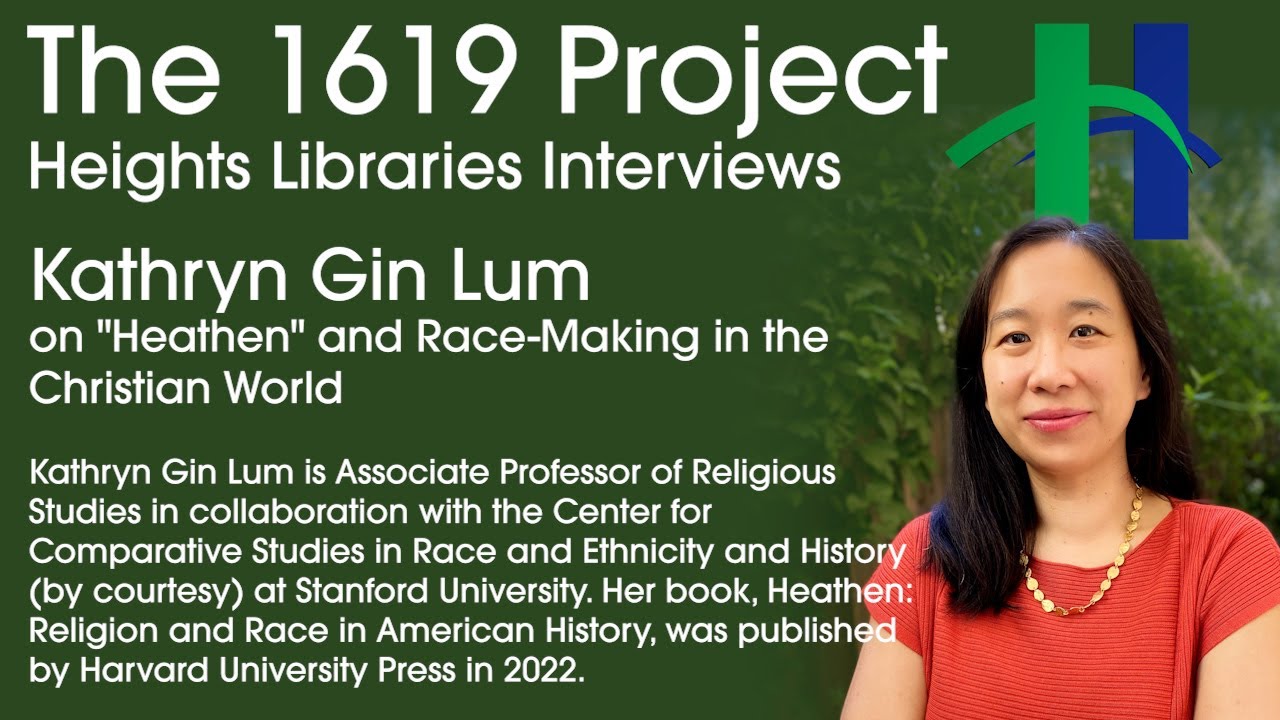
Kathryn Gin Lum: Heathen and Race-Making in the Chirstian World
Kathryn Gin Lum is Associate Professor of Religious Studies in collaboration with the Center for Comparative Studies in Race and Ethnicity and History (by courtesy) at Stanford University. Professor Kathryn Gin Lum discusses her book, "Heathen: Religion and Race in American History ." Prof. Lum begins by explaining the Doctrine of Discovery and how the colonizers of the Americas imported the idea of the pagan or heathen. How Christian missionaries came to understand native…
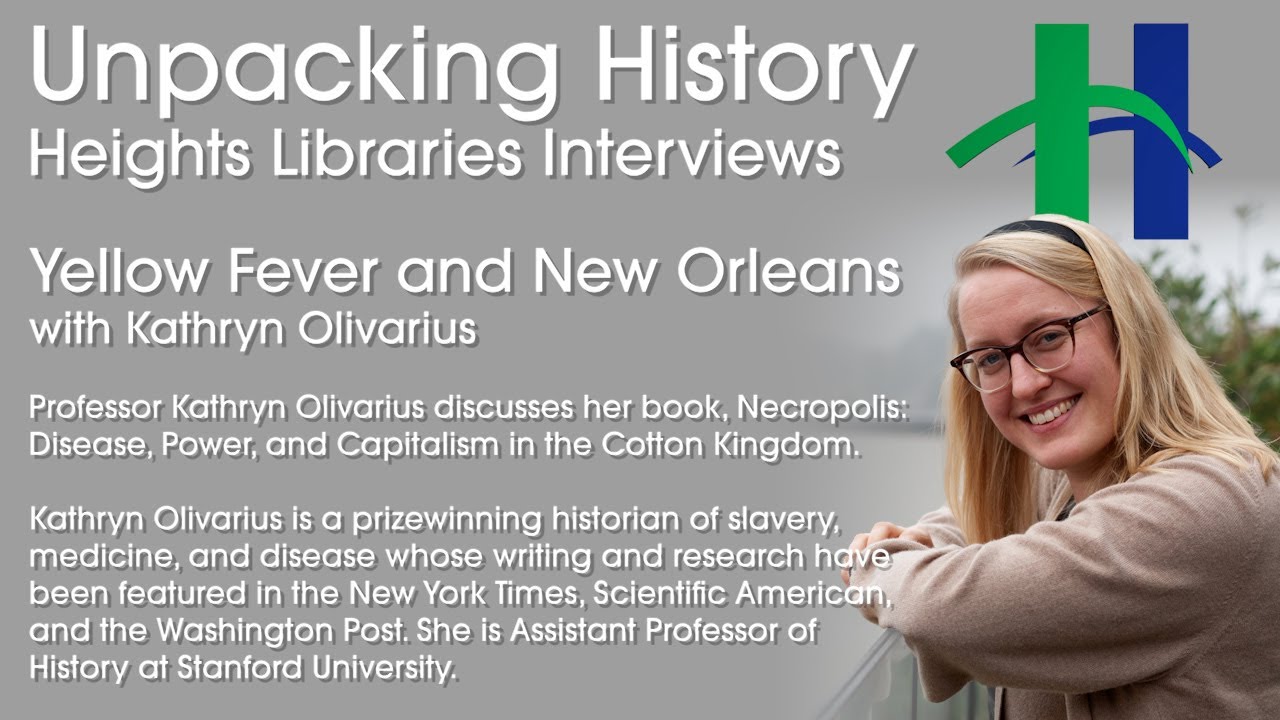
Kathryn Olivarius: Yellow Fever and New Orleans
Professor Kathryn Olivarius, Assistant Professor of History at Stanford University, discusses her book, Necropolis: Disease, Power, and Capitalism in the Cotton Kingdom. Professor Olivarius uses yellow fever to frame how wealth, class, and race developed in the economic powerhouse antebellum city of New Orleans. Developing from three vector points of disease, acclimation, and immunocapital the social and political elite held their grip over the economics of the city by weaponizing yellow fever.…